






Is Your Dog Ready for the Holidays? Here Are the Top 5 Holiday Dog Training Tips for Calmer Canines.
|
|
Time to read 7 min
|
|
Time to read 7 min
When my husband, Brian, and I were newly married, I was excited to host our first Thanksgiving with my in-laws. They had traveled all the way from Chicago to our new home in New Orleans. I don’t know who was more excited - us, them, or our four rescue dogs, Shelby (Pit Bull mix), Desoto (Catahoula Leopard), Darby (Dal-A-Bull mix), and Jolie (Dalmatian). This was years before I became a professional trainer. Honestly, when I look back on this particular holiday gathering, I cringe.
I wanted everything to be perfect. Yet it never occurred to us to work on dog manners specifically for holiday festivities. Which is especially laughable in hindsight because my in-laws are good people, but not dog people. You’d think we would’ve wanted their grandpups to be on their absolute best behavior and not leave anything to chance. After this terrible Turkey Day mishap, we vowed to do better by our dogs and our guests.
Read on for the five holiday dog training tips that helped us keep our promise.

As soon as my in-laws walked through the door, I knew we were in trouble. All four dogs rushed them, eager to see who was the cause of us cleaning the house like crazy for the past few hours. (Ever notice how we change our routine when company is coming? Our dogs sure do!) Despite our loud reminders not to jump, Shelby and Darby decided to decorate my mother-in-law’s light-colored pants with dirt-colored paw prints. The chaos continued as we attempted to guide our guests past four slobbery tongues and shin-slapping, wagging tails to the living room. There the dogs bounced on the sofas like toddlers who had gulped down an entire sugar bowl.
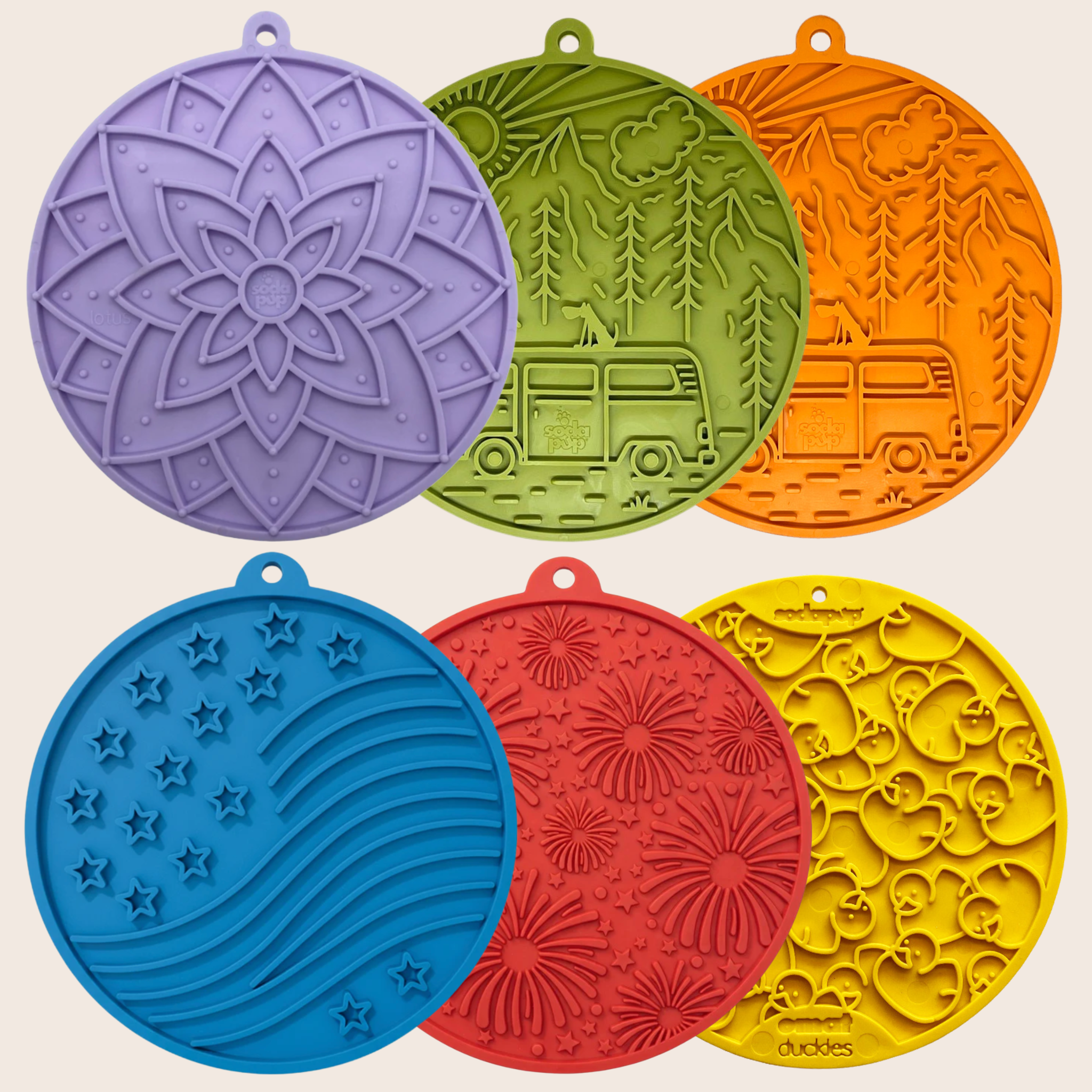
If there is one thing you can do to improve dog behavior with house guests – at the holidays or any occasion – it’s this: put your dog in a crate or room where they cannot see the people enter the house. Give them a cute, holiday-themed slow feeder bowl or lick mat from Farm To Pet to keep them busy if they’re prone to temper tantrums due to FOMO. That allows you to welcome your company and give them your full attention as you show them to a seating area. Once your guests are settled, and your dog is calm and quiet, you can release your dog to go say hi. Discovering a new person in the house is a positive, versus seeing a person enter – which can feel like they’re an intruder. (I always wonder what dogs think the first time they see a person coming out of a wall, aka drive thrus. Thank goodness for Pup Cups!)

The greeting chaos had subsided once the four of us were seated on the sofas. But the moment my husband and father-in-law stood up to go in the kitchen and check on the turkey, the dogs crowded around them. Clearly, it was play time. Why else would the humans be on the move? Once they realized the destination was the kitchen - and that great-smelling food - they couldn’t run ahead fast enough. I was worried that one of them would trip my father-in-law, and he would fall and break an arm.
Teaching our dogs “go to place” would’ve made that a much more pleasant and safer experience for all. If you have multiple dogs, individual crates or elevated cots are best when training this obedience skill. They provide a clear, visual place to go and stay, and it’s easier for us to see if the dog isn’t completely in the crate or on the cot. If you enjoy training to an advanced level, go to place can be any spot where the dog can lay down comfortably, such as a rug or on the couch (if you allow your dog on the furniture). Now when we host holidays, I say, “places, everyone!” and the senior dogs go to their respective spots on the sofas. If we have a puppy or adolescent dog, I say, “go to your crate,” and they hustle in. It wouldn’t be fair to expect young dogs to go to place or stay in position with so much excitement. Gradually, we add distractions to training.

After about an hour of us visiting with my in-laws in the living room, I was feeling relaxed. Finally, our Thanksgiving was going the way I had hoped it would. Soon, we’d be eating a fantastic feast that my husband cooked for us. Then I realized it had gotten awfully quiet. I looked for the dogs. Desoto was at my feet, Shelby was curled up on the couch next to my father-in-law, and Jolie was between me and my husband.
Wait, where was Darby? Just then, we heard a loud clang in the kitchen.
“Oh no, the turkey!” yelled Brian. He had taken it out of the oven and put it on the counter. I have never seen him sprint so fast in my life. Of course, the other three dogs scrambled after him, and that’s when the real chaos started.
Needless to say, unless your dog has successfully practiced impulse control and “leave it” around high-value food, do not tempt your dog by putting a mouth-watering, roast turkey on the counter unsupervised. Go to place is an excellent cue for the kitchen to teach your dog not to be underfoot or countersurfing. However, if you are not there to reinforce good behavior such as place or four on the floor, I recommend management, such as a baby gate to prevent the dog from entering the kitchen.

I followed everyone into the kitchen and was horrified to see our Thanksgiving turkey on the floor. A very pleased Darby was guarding her treasure from Brian and the rest of the pack. She growled and postured, eyes staring, body stiff. No way she was giving this up!
The mistake most people make with resource guarding is using a bribe. Combine that with putting physical pressure on the dog by approaching them to take away something they value, and you have the beginning of breaking trust. A dog who does not trust you will not willingly give up something they value. The key is teaching your dog the training cues “out” (release to my hand), “drop” (release at my feet), and bartering well before you need any of these skills in an emergency such as oh, let’s say a delicious 10-pound turkey.
Fortunately, miracles do happen. Darby respected Brian’s tough love “Dad voice” enough to let go of her prize turkey … but not before tearing off a wing. The other dogs wanted a go at the big bird, but they listened to my pleas to return to me and my in-laws in the living room. Brian, the resourceful chef that he is, was able to salvage enough of the turkey that our Thanksgiving dinner wasn’t a total loss.

After the embarrassment of Darby stealing and partially eating our turkey dinner, you better believe I was eager for our evening to come to an end. We finished our holiday meal, followed by coffee and pumpkin pie. I kept a wary eye on Darby, who was just chastised enough not to grab anything off of our plates, but was at the ready to pounce on any crumbs that tumbled to the floor. Finally, it was time for our guests to bid goodnight and head back to their hotel. We escorted them to the door. Our social butterfly, Shelby, wanted to go with my in-laws! We had to hold her back to prevent her from tripping them, or bolting out the door after them.
In hindsight, we all would’ve enjoyed our meal more if the dogs were crated or trained to go to place so they didn’t beg at the table. When it was time for our guests to leave, we could’ve used that same solution to ensure the humans stayed upright and the dogs remained inside. Which is exactly what we do now. Thanks to Farm To Pet, our current pack of three dogs and two cats can enjoy delectable turkey treats while our family feasts on our own turkey.
My naughty girl, Darby, passed away many years ago, at the impressive age of 16 years old. (She was my best teacher, and no doubt lived so long because I had a lot to learn.) She was an accomplished agility dog, but when I tell stories about her, it’s never about her titles or ribbons. It’s the extreme eating stories (ask me about the 98 frozen hot dogs!) that bring tears to my eyes and make my friends howl with laughter.
Do you have dog drama at the holidays? If your dogs are like the Bumpus hounds in A Christmas Story, there’s still time to teach them good manners, which is the best holiday gift you can give. Sign up for an obedience class (in person or online), or hire a positive reinforcement trainer to come to your home. Wishing you and your pets very happy, well-behaved holidays!

Julia Lane, CPDT-KA, is a certified, professional dog trainer who has taught hundreds of dogs and their people for 20 years. She has competed in agility, disc dog, nose work, and rally obedience with her variety pack. She has trained many Therapy Dogs, who bring joy and smiles to seniors and children. She lives in a 1940s farmhouse, the Country K9 Cottage, in the Chicago suburbs with her husband, son, two Border Collies, one rescue Pit Bull, and two sassy cats. She can be reached at www.SpotOnK9Sports.com.


